New Discourses
Politics • Spirituality/Belief • Writing
A Communist Manifesto for Christian Nationalists: Testing the Woke Right
by James Lindsay
December 03, 2024
post photo preview

As many of you know and fewer appreciate, I have been aiming to expose a phenomenon called the “Woke Right” for some time now. This whole matter is an issue of considerable and rather fierce debate.

Is “Woke” the right word for them? Are they really “Right”? Should we call them something else? Is this really even happening? Does it even matter? Is this even important?

Each of these is a worthy enough question and matter for its own debate, but regarding the question of whether “Woke” is the right term for them, I haven’t been fully convinced despite my heavy use of the term. As you’ll see momentarily, I’m now far more convinced.

So far, I have attempted in various X (née Twitter) arenas to explain why I think the term “Woke Right” fits and to identify some examples, and I’ve done a couple of podcasts explaining the phenomenon and making the case more fully. I’ve also done a number of interviews. Still, it remains an open question, are they really Woke, so I decided to do a little experiment. A throwback to an earlier James, if you will. And, as it happens…

We are so back.

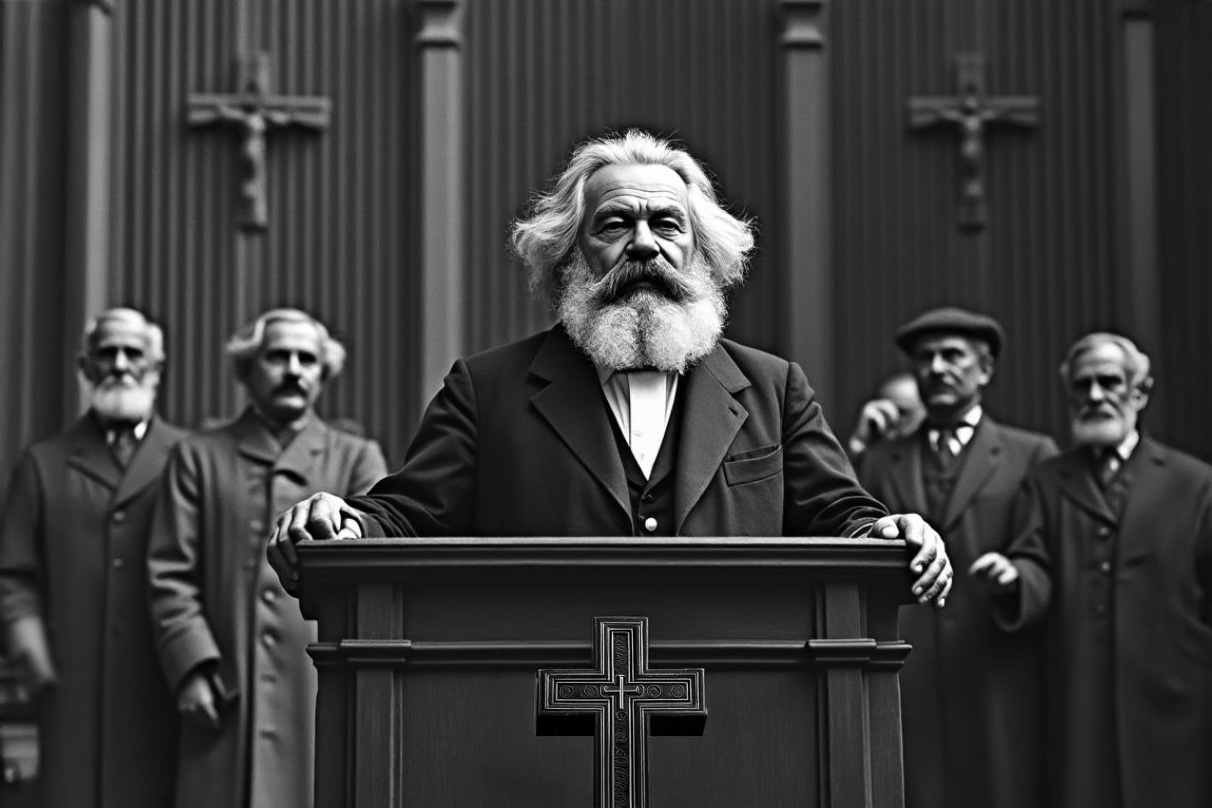
To put the conclusion out front before I explain myself, I figured a good way to test the “Woke Right” for Wokeness would be to submit a little hoax essay to what I presume is their flagship publication, American Reformer. To produce this “Woke Right” hoax, I took a couple thousand words straight out of The Manifesto of the Communist Party, by Karl Marx and Friedrich Engels (better known as the Communist Manifesto), and lightly modified it into a “Woke Right” critique of liberalism, which the so-called “Woke Right” hate. They published it: The Liberal Consensus and the New Christian Right (It’s archived here in case they take it down).

I figured there’s nothing more definitively Woke than the Communist Manifesto, so I think we can drop with the inverted commas here and get on with calling them the Woke Right after this. They published Karl Marx’s definitive Communist work, dressed up to resemble their own pompous, self-pitying drivel, when it was submitted from a completely unknown author with no internet footprint whatsoever bearing the name “Marcus Carlson” (get it? Haha).

That question answered raises the deeper second question above—which I will not address here—about if they are really on the “Right,” as they consistently claim they are. For them on this, I’ll only say, I have been using the term “Right Hand of the Left.”

So what did I do, and why did I do it? Before explaining myself, I’ll explain the mechanics of this little prank.

I started by taking the preamble and then just short of six continuous pages of text from the first chapter of The Communist Manifesto. This chapter is titled “Bourgeoisie and Proletarians” and is the part of the manifesto where Marx and Engels make the case that the bourgeoisie (middle class, owners, management, and wealthy) as a class is abusive of the proletariat (workers) as a class in just about every way you could imagine. I then rather crudely swapped out references to the bourgeoisie with something to do with either liberalism, liberals, classical liberalism, or their real and mighty bugbear that they call “the post-war liberal consensus,” which they believe oppresses them. Concurrently, I swapped out references to the proletariat with references to an object they call the “New Christian Right” as a way of referring to themselves. I then massaged some of the specifics for fit, flourish, and flow, cut a bunch and consolidated to fit the word count requirement, attached the document to an email from a made-to-order burner account, and hit “send.” A few days later, they published it on American Reformer with minimal edits.

So far as these terms of art go, meaning “post-war liberal consensus” and “New Christian Right,” I didn’t invent them. I took them from a couple articles published on American Reformer aiming to describe their own movement, what it’s about, and what it believes oppresses them. While these are technically terms to explain in another time and place, what I noticed (when re-reading The Communist Manifesto to prepare a pair of podcasts about it) is that Marx’s complaints about the bourgeoisie and vision of the proletariat match what I had read on American Reformer itself about the Woke Right with regard to the “liberal consensus” and liberalism along with their vision for a New Christian Right. It required shockingly minimal editing to make Karl Marx’s arguments transform into Woke Right arguments about American liberalism. (In fact, I have the original first step document in its raw form, if anyone wants to see it, revealing just how fast the connection is.)

So, that’s what I did. Why did I do it? And why target American Reformer?

I don’t have any particular animus against American Reformer to speak of, but so far as I know, it’s the flagship publication for what I’ve been calling the Woke Right, or at least the Protestant “Christian Nationalist” (or, “Ecumenical Integralist”) wing of the Woke Right. It makes a good target, though, because American Reformer represents not the cringe-inducing (antisemitic) fringe of the Woke Right but its more respectable, mainstream wing. Beyond that, I know rather little about it because, as I’ve said many times, I mostly find the Woke Right to be an enormously irritating distraction that I don’t actually give much time to and try to avoid thinking about entirely. Wandering into Woke Right thinking is far too easy a mistake for us to keep making, I keep telling myself, but we, as a loose coalition, keep making it. Maybe that’s because it has a ton of money behind it and because they use divisive Woke dialectical tactics to divide movements and collect supporters….

What I learned doing the Grievance Studies Affair, however, is that if you can’t tell people about an ideological problem out there in the world, you can show them instead by participating directly, if disingenuously. That is, you can hoax them and get them to publish a blatant caricature of their own beliefs in an embarrassing yet informative way. Rather famously, I, et al., got a feminist social work academic journal to accept a rewrite of a chapter of Hitler’s Mein Kampf as a pathway forward for intersectional feminism as a movement.

Moreover, I learned that if you’re going to target publications for a “hoax-ish” exposé, you should aim at the most significant one you can. That turns out to be American Reformer, which I also featured in one of my podcasts about the Woke Right. (Incidentally, I learned almost all I really needed to know about the Woke Right, their arguments, their mentality, etc., from that one article I read for the podcast, which isn’t surprising because Woke Right “philosophy” is effectively just another Grievance or Woke architecture, and these are all extremely easily produced once you know the names for various pieces and the specific accusations attached to them.)

Why did I do it? That’s a lot simpler. I suspected that the so-called Woke Right really is Woke; many people disagreed; and I wanted to test that hypothesis instead of arguing about it to very little effect. Up to now, when I have pointed it out, argued it, explained it, and discussed it, I’ve been vigorously assured I’m completely wrong and this “New Christian Right” is not Woke at all. In fact, I learned I’m the bad guy here: “attacking Christians,” “punching Right,” “punching down” (amusingly), “gatekeeping,” and “being subversive, divisive, or [insert any of many slurs].”

Well, I’ve been here before, and back then a simple test sufficed. I ran this test once in the Grievance Studies Affair to expose the Left in academia. It was easily replicated against the so-called Woke Right. The result, though limited in scope, is a positive one. The Woke Right is Woke enough to argue against liberalism in exactly the same pompous and conspiratorial way (literally) Karl Marx argued against his own class enemy. So, if by “Woke” we mean running the Woke operating system and sociopolitical architecture, the Woke Right is clearly Woke.

So, circumstances relevant to the Woke Right also compel me to ask, is this me attacking Christians or “dividing the right”? Well, no. You are free for yourself to decide if the “New Christian Right” represents Christians or Christianity, but this was little more than a simple test to see if they’re a Woke duck. They walk like a Woke duck. They talk like a Woke duck. They’re a Woke duck.

They considered a lightly modified excerpt from the Communist Manifesto to be a “powerful article” for who they are and what they think (that we can expect they will not stand behind now that they know what it is, of course). If that aligns with Christianity is something for others to decide. If spotting this worrying Woke trend as it permeates the movement to stop Woke is “dividing the right,” maybe using terms like “right” here isn’t what we need to be doing. Maybe we should just be stopping Woke, however it presents itself.

Does this mean I’m saying the Woke Right are Communists? No, not at all. Historically, Fascism was a reaction to Communism that adopted the Communist operating system but not Communism or its specific agendas. In fact, they adopted the operating system of Communism specifically to be “anti-Marxist” (according to Mussolini)—just like the Woke Right. I do not think the Woke Right are Communists—aside from some infiltrators who must certainly be taking advantage of the Woke Right movements. I think they have taken up the Woke operating system, nothing more, nothing less. I do hope we won’t now repeat obvious historical mistakes, but I’m not accusing them of being Communists. They did not accept a Communist, qua Communism, text but a modified version that flatters their sensibilities.

In fact, it’s rather the opposite, in a way. The Woke Right, or at least the nerd-macho “New Christian Right” at American Reformer, etc., positions itself as the only viable solution to Communism in the West. In fact, their niche is something like being the only outfit, broadly construed, that is capable of equipping the American Church of resisting Communism—and certainly they have positioned themselves vigorously against my work as being productive to that particular cause. Well, as is evident, they haven’t done their homework at all. Clearly, my hoax essay only passed editorial muster because, it is now abundantly clear, these particular fellows are unlikely even to have read the Communist Manifesto. If winning a war requires knowing your enemy, as Sun Tzu said, they don’t even recognize him when he shows up on their own front door.

As a final question, you might be wondering how tight this hoax is. I’ll let you judge for yourself. Here (pdf), you’ll find a document showing the whole story in four appendices: a comparative back-and-forth text, the final submitted text (American Reformer published a very lightly edited version of this), the relevant sections of the Communist Manifesto, and my initial word and concept–swap so you can see my process before the final editing. A small sample of the back-and-forth text, from beginning and end, are offered here as a taste.

Communist Manifesto:

[p. 27, preamble] A spectre is haunting Europe – the spectre of communism. All the powers of old Europe have entered into a holy alliance to exorcise this spectre: Pope and Tsar, Metternich and Guizot, French Radicals and German police-spies.

Where is the party in opposition that has not been decried as communistic by its opponents in power? Where is the opposition that has not hurled back the branding reproach of communism, against the more advanced opposition parties, as well as against its reactionary adversaries?

Two things result from this fact:

I. Communism is already acknowledged by all European powers to be itself a power.

II. It is high time that Communists should openly, in the face of the whole world, publish their views, their aims, their tendencies, and meet this nursery tale of the Spectre of Communism with a manifesto of the party itself.

American Reformer:

A rising spirit is haunting America: the spirit of a true Christian Right. Moreover, all the existing powers of the American Regime since the end of the Second World War have aligned themselves against it and its re-emergence from the shadows of American civic life, politics, and religion—the Marxist Left and its neo-Marxist “Woke” descendant, the liberal establishment, the neoconservatives, and their police and intelligence apparatuses.

There are two consequences of this unholy alliance. First, the Christian Right itself is recognized by all these forces to be a power and thus a threat. Second, it is time for this arranged order to end and for a New Christian Right to emerge and stake its rightful claim on twenty-first century American politics.

The Communist Manifesto:

[pp. 36–37, ch. 1] This organisation of the proletarians into a class, and, consequently into a political party, is continually being upset again by the competition between the workers themselves. But it ever rises up again, stronger, firmer, mightier. It compels legislative recognition of particular interests of the workers, by taking advantage of the divisions among the bourgeoisie itself.

American Reformer:

This organization of the New Christian Right into a movement will continually be upset again by the competition between its various factions, but it is rising. We take no enemies to the Right and always redouble our efforts to our Left. In that way, we ever rise up again, stronger, firmer, mightier for all these contests. For this reason, in the end, we will win back our culture and take back our communities, and the liberals can go ahead and thank themselves.

I’ll close here and open the space for discussion. This is my explanation for this little experiment. My conclusion is that I validated my hypothesis in a significant way that will advance the debate. The Woke Right is Woke. They saw themselves in what can only be called a “Communist Manifesto for Christian Nationalists.”


community logo
Join the New Discourses Community
To read more articles like this, sign up and join my community today
2
What else you may like…
Videos
Podcasts
Posts
Articles
The Effect of Social Media on Introverts and Extroverts | James Lindsay & Joe Rogan
00:01:38
Why Did I Write Those Hoax Papers? | James Lindsay
00:01:30
Hypotheses Are Not Conclusions | James Lindsay, Peter Boghossian, Joe Rogan
00:01:22
Milestones, Vol. 1: Islamist Bolshevism

The New Discourses Podcast with James Lindsay, Ep. 187

What is Islamism? Is it the same thing as Islam? Has it varied over time? What's its relationship to Communism, at least in our present era? These are important questions, particularly in light of the undeniable force of the Red-Green Alliance currently besetting the West. Against the backdrop of American leaders naming the Muslim Brotherhood a terrorist organization, at least in limited fashion, it's a worthwhile endeavor to explore its intellectual underpinnings, which were recorded by Sayyid Qutb in a book called Milestones (https://amzn.to/48QcfHR) in 1964, two years before he was hanged in Egypt for his radicalism. In this episode of the New Discourses Podcast, host James Lindsay goes through the introduction of this book and explains its deep similarities to the Leninist Communism Qutb was immersed in before radicalizing, particularly Lenin's 1902 tract What Is to Be Done? Join him for insight into this important work that ...

Milestones, Vol. 1: Islamist Bolshevism
What Werewolves Can Teach Us About Political Warfare

New Discourses Bullets, Ep. 138

As it turns out, a small number of bad actors who have an informational advantage over a much larger but naive population in turn have a gigantic strategic advantage over that same population. In order to demonstrate this fact and make it popular, a Russian student some decades ago devised a popular party game called "Mafia" that, after spreading to Western nations, got rebranded "Werewolves." This game can teach us a lot about how a small band of actors who are deliberately coordinating with one another can extract an enormous strategic advantage over a population who doesn't realize who the bad actors are or that they're coordinating. Join host James Lindsay for this fascinating episode of New Discourses Bullets where he explains the relevance of this game and its lessons to our everyday experience of political warfare environments.

What Werewolves Can Teach Us About Political Warfare
The Alchemy of the Dialectic

The New Discourses Podcast with James Lindsay, Ep. 186

The dialectic is ultimately the engine of all Marxist and Hegelian thought and also underlies Fascism and the conflict between Fascism and Marxism. It is also fundamentally Sociological Alchemy, as the Soviets both knew and admitted. Based on Marx's ideas about dialectical materialism as the fundamental law of all of Nature, including Man, the Soviets outlined three key dialectical laws and taught them to every school child and party member. First, there is the transformation of quantity into quality, and vice-versa. Second, there is the struggle and unification of opposites. Third, there is the "negation of the negation," which most people know as "problem, reaction, solution" in practice. In this episode of the New Discourses Podcast, host James Lindsay introduces these three dialectical laws of Marxist and Soviet thought and brings them alive for you while comparing them to the social alchemy of George Soros and the ancient ...

The Alchemy of the Dialectic
4 hours ago

It's late and should have been in bed some time ago. I was up studying music.

Ever since Charlie Kirk's public execution, hinting at the idea that it was worse than a "mere" assassination, but a broad daylight pubic execution carried out at a college campus to teach resistance peeps a lesson. Horrifying, just horrifying, nightmarish. Some on the right seem to have lost their marbles since. I now infrequently watch the news.

Understandably many outside of the US hate Trump. I get it. At the same time, ever considered getting rid of tariffs on imported US goods and the like?

Anyway, we all got to witness a brutal public execution on a college campus, supposedly the most open to ideas place on Earth but far from it. I am thinking Iran would have a hard time competing.

That was a big deal.

January 16, 2026

On Tousi TV Orwellian nightmare under Sadiq Khan and Britain’s Fabian wolf government

Woke Left. Woke Right. Woke Anything.

Woke identifies what it is. Any other attached words merely identify what Woke is pretending to be.

post photo preview
The Third Rail and the Fifth Column
by James Lindsay

During the Spanish Civil War in the late 1930s, Nationalist Generalissimo Francisco Franco advanced on Madrid with the intention of taking it with four columns of soldiers. In the midst of the advance, another Nationalist general, Emilio Mola, was asked on a radio broadcast which of the columns would succeed in taking over the city and finalizing the Nationalist coup. Mola replied that it would be the hidden “fifth column” of supporters and sympathizers within Madrid who would prove decisive by rising up and sabotaging the Republican defense from within.

Ultimately, General Mola was wrong. No “fifth column” arose from within the city, and the Republicans held Madrid. Nevertheless, the phrase immediately caught on. A fifth column to this day refers to a group of people who undermine a larger group, institution, movement, or nation from within.

The Woke Right is a Woke fifth column working internally against America, MAGA, the (American) Republican Party, and the American conservative movement, which is the last anchor tethering our country to the Constitution, common sense, and reality. Whatever might be its primary sources of intention and energy—be those foreign influence, “Deep State,” Democrat, or an organic and opportunistic paleoconservative revolt, or some combination—being a fifth column in the Woke assault against American and the West is the role it certainly plays.

The question is how it has been so successful at recruiting and gaining momentum, given that many of its views are wildly out of step with American values and the traditional perspectives of conservatives in America. Their nativism, isolationism, (genuine) racism, hostility toward Jews and Israel, racial minorities, women, sexual minorities, and legal immigrants, and undeniable antisemitism, not to mention their skepticism of free-market economies, the Constitution, religious liberty, conservatism itself, and a minimalistic state, do not reflect the values of generations of American conservatives or America overall.

Many reasons can be given for their meteoric and bewildering sudden rise. Among them, broad distrust in established institutions and favoring “trusted voices” within the movement who appear to be leading them astray is perhaps at the front. Frustration with the difficulty in pushing back against the Woke Left and its infiltration into our institutions is surely another significant component. Multiplying and tapping the alienation of our young men is definitely another. The outright force of money and the apparently sudden shift of so many voices all at once just in the last year, taking the movement by sudden surprise, must also contribute.

Both within and beyond these reasons, however there is a motivating factor that demands our attention: recruitment upon the “third rail.” The third rail, unlike the fifth column, is a metaphor. It literally refers to the electrified “third” rail subway trains use to power themselves. The idea is that if you were to fall down into the tracks, touching either of the first or second rails, where the wheels of the trains run, would result in nothing particular, but stepping on the electrified third rail would result in your electrocution and destruction.

The “third rail” metaphor therefore describes locations in political discourse that, if touched, will blow up your (professional) life. To the politically naive, these opinions appear to be benign, perhaps even statements of fact, but they work like a political tripwire, causing a huge reaction when they’re aired. A classic American example is attempting to explain the cultural significance of Confederate symbols to many (especially Southern) Americans. No matter how accurate, nuanced, or careful the speaker might be, it will likely be taken as a defense of slavery and sedition, and damage someone’s reputation or career (especially a political career).

Here’s the problem. A population can be pushed to the point where it will regard as bogus and evil the destruction an honest person can expect to receive for stepping on a third rail. For example, someone who earnestly defends the meaning he and many others hold for Confederate symbols might get blown up for “defending slavery,” even though he didn’t. If that happens enough, in unfair enough ways, for long enough, the public might revolt against the injustice of the political third rail.

That’s where we find ourselves with many issues all at once now as the lies of the extended Woke Left collapse around us, and the Woke Right fifth column is recruiting precisely by taking advantage of that situation.

There are two particular dynamics that have played a crucial role with regard to what we might call the Politics of the Third Rail that has enabled the rise of the Woke Right as a fifth column.

First, there’s the uncomfortable fact that many points that reside on the third rail are at least partially true but remain completely politically incorrect. This mismatch is a political powder keg; a bomb waiting to go off. When people aren’t allowed to say true things for undeniably political reasoning, the taboo is regarded not as politeness but censorship of potentially important or meaningful views. A reaction that embraces these views is more or less eventual in such a circumstance, and chances are, it won’t be nuanced when it arrives.

In fact, it usually will not be nuanced at all. The nuanced, careful, accurate voices will already have been shouted down, punished, or destroyed by the time the backlash arrives. The only voices left will not only be less careful by definition but will also be angry enough to assert more than the full truth of the issue. With regard to the issue of the Confederacy, they will not stop at the idea of revering a “heritage” of sovereignty and not being told what to do by a meddling federal government or outside power. They may start explaining why, in their view, slaves were better off than black freemen later, up to and including today.

Because these brash voices look brave and honest compared to the effete political correctness they’re shattering, they’re attractive. They will recruit followings. These followings will, by their intrinsic dynamics, go too far. Worse, by then, even if more reasonable voices step into the fraught space, they’ll sound timid, rather than brave, for their measured approach to the controversial issues, and they’ll fail to stem the tide as it flows toward radicalism and insanity

Second, there’s the fact that the “politically correct” Woke Left has created more, and more obviously bogus, political third rail space than any polite society ever could dream of—or that one will tolerate indefinitely. Undeniably true things like that it is perfectly acceptable to mention the completely banned “n-word” without using it—say by quoting Huckleberry Finn, or explaining the historical use of the term itself, or quoting a popular hip-hop song that says it every second line, or explaining that certain words in Mandarin and Korean sound similar but aren’t it and saying those—are rendered completely verboten, and seemingly arbitrarily. One will notice, for example, that “black people are allowed to say it,” and that many do, enthusiastically, casually, and even viciously, but that a racial double-standard has to be maintained for what appears to be “Woke” reasoning.

The result of this Wokification of discourse is that there’s an incredible and intolerable amount of patently ridiculous discursive and political “third rail” space that makes a great deal of honest discourse and real, necessary problem-solving impossible. As problems mount, the maintenance of the political third-rail space rightly begins to be identified as a big part of the festering problems, and it will be rebelled against. As this political and discursive pendulum swings back, as described above, it will not do so gently.

This isn’t a matter of mere perception, petulance, or, especially, latent bigotry, as the Woke Left and too many in polite society might assert. It is actually the case that the Woke Left has over the last two or three decades succeeded in turning an incredible number of legitimate political and cultural concerns into third-rail space that can hamper communication, prevent finding solutions to genuine problems, chill speech, and unjustly ruin lives. It is as though the Woke Left turned the first and second rails into electrified rails, preventing the train from being able to run and making its very carriages pose a real danger of electrocution.

It is both in and upon this greatly expanded third-rail space in political discourse that the fifth-column Woke Right has succeeded in doing most of its recruiting. Both in the name of and by “boldly” stepping onto the first and second rails, which are unjustifiably electrified, they have occupied both bogus and real third-rail political space and stand inside it as defiant rebels, unafraid of the shocks and calling people to join them. What it represents is freedom, fun, and liberation from an oppressive political, professional, and discursive regime that took advantage of the fundamentals of polite political taboos in order to steal and abuse power. It is therefore a successful recruiting methodology for a radical reactionary movement that rejects not only the bogus political correctness of Woke Left cultural mores but also the genuine guardrails of polite society in favor of a new form of liberation.

The fifth columnists in the Woke Right are using this dynamic to recruit and to drive wedges that undermine their political targets, particularly the United States itself and its conservative movement and institutions therein.

When we see commentators like Tucker Carlson “just asking questions,” what he is doing is stepping into third-rail space and recruiting, including many people who know better but are also now too pissed-off to care. When we see agitators like Nick Fuentes transgressively violating taboo after taboo (with what amounts to Right-wing Queer Theory), what he is doing is standing directly on the third rail and laughing as he redirects the bolts back at his enemies. When we see hordes of “Dark MAGA” influencers follow suit, they’re leading an army of mostly disaffected young men to fill the vacuum created by altogether too much third-rail space in contemporary cultural and political discourse, much—but importantly not all—of it artificial, odious, and purposefully malicious in the first place.

Thus, a fifth column that seeks to destroy America through its conservative movement has been able to recruit an angry army that has become shameless in the process of shedding false causes for shame. The are the fifth column standing on the third rail, and they threaten to undermine our shining city on the hill from within as our enemies advance upon us from without.

How can they be dealt with? One way only exists to us. We must steal their thunder (pun intended

We have to be honest. We have to occupy third-rail space ourselves with honesty, integrity, and nuance. We must be unafraid to tackle well these touchy issues that the Woke Right fifth-columners are tackling badly, and we must create a new civic norm of championing, not attacking, those who enter those spaces honestly and in good faith in order to deal earnestly with what partial—or sometimes full—truths reside there.

Read full Article
post photo preview
Reciprocal Tolerance
by James Lindsay

In a footnote in his famous (or infamous) The Open Society and Its Enemies, Karl Popper relates a famous (and famously misunderstood) idea called the Paradox of Tolerance. It is, as it turns out, one of the most important concepts that any free society much reckon with—and solve.

Popper only devotes a single paragraph to this fundamental paradox of freedom, which can be summarized as “being tolerant of intolerance eventually results in an intolerant society, but being intolerant of intolerance is already a feature of an intolerant society.” In that paragraph, he outlines a solution, though he’s thin on the details. Here’s how he phrases it, in full:

Less well known [than other paradoxes] is the paradox of tolerance: Unlimited tolerance must lead to the disappearance of tolerance. If we extend unlimited tolerance even to those who are intolerant, if we are not prepared to defend a tolerant society against the onslaught of the intolerant, then the tolerant will be destroyed, and tolerance with them. In this formulation, I do not imply, for instance, that we should always suppress the utterance of intolerant philosophies; as long as we can counter them by rational argument and keep them in check by public opinion, suppression would certainly be most unwise. But we should claim the right to suppress them if necessary even by force; for it may easily turn out that they are not prepared to meet us on the level of rational argument, but begin by denouncing all argument; they may forbid their followers to listen to rational argument, because it is deceptive, and teach them to answer arguments by the use of their fists or pistols. We should therefore claim, in the name of tolerance, the right not to tolerate the intolerant. We should claim that any movement preaching intolerance places itself outside the law and we should consider incitement to intolerance and persecution as criminal, in the same way as we should consider incitement to murder, or to kidnapping, or to the revival of the slave trade, as criminal.

Radicals on both the Left and the Right have run with this famous paradox of free societies in various ways. For example, it is popular on the Left to present only Popper’s conclusion about claiming the right to suppress intolerance without expressing his rather strict criteria for that suppression. On the (radical) Right, on the other hand, this formulation has been criticized (e.g., by R.R. Reno in Return of the Strong Gods) as planting a dialectical seed that turns tolerance into totalitarian intolerance over time

In these analyses, the Left is dishonest, and the Right is simply wrong, as is their wont in each case. The Left desires, like their Nazi pseudo-nemesis Carl Schmitt, to have the power to declare the intolerant enemy and have him destroyed without acknowledging how seriously Popper takes the conditions of such action. The Right simply fails to recognize that the devil is in the details for working with such a situation in reality. Of course, by way of its error, the Right also desires, like their Nazi semi-hero Carl Schmitt, to have the power to declare the enemy and have him destroyed.

Though Popper doesn’t develop the idea further, and though the devil will remain in the details, he does lay out criteria by which intolerance of the intolerant might be acted on wisely, as opposed to unwisely, to borrow from his own phrasing. This is where the rubber meets the road for the Paradox of Tolerance, to quote the relevant section again

…for it may easily turn out that they are not prepared to meet us on the level of rational argument, but begin by denouncing all argument; they may forbid their followers to listen to rational argument, because it is deceptive, and teach them to answer arguments by the use of their fists or pistols.

What Popper is proposing here, though thin on the details, is a theory of tolerance in free society. He is saying we must retain the right to suppress intolerance that might answer our tolerance with a combination of irrationalism, intolerance, and violence. He clearly states we should regard such militant and subversive intolerance as a kind of incitement and refuse to protect it as free expression.

In practice, this is trickier than can be contained in a footnote. It is not sufficient to invoke legal intolerance against views that are merely irrational, anti-rational, that denounce argument, or that forbid followers from listening to rational arguments because they are allegedly deceptive. The law already has some mechanisms for dealing with intolerance that looks to answer arguments with fists and pistols, imperfect as those might be. Further, these are not the central part of the problem of overreaching tolerance.

Popper seems to miss the most essential characteristic for finding a strong solution to his paradox. This essential characteristic is located in the fact of the paradox itself: the intolerant will not reciprocate tolerance, given the opportunity. In essence, what he is looking for, but does not find, is a Golden Rule for the issue of tolerance.

We might call such a strong solution Reciprocal Tolerance. In short, Reciprocal Tolerance would be a doctrine like: we, the people of a free society, should extend tolerance only to any who, given power over us, would also extend tolerance to us in return. That is, we will treat others as we can reasonably expect they would treat us, as determined from their own words, deeds, charters, relationships, and organizational principles.

This principle of Reciprocal Tolerance is not reversible like through some postmodernist trick or psychopathic “DARVO” because it is applied from a free society. In full generality, it is that free societies are perfectly free to be intolerant of any politically intolerant political organization.

This principle is also not a principle regarding speech. People are free to say whatever intolerant, hateful, or bigoted thing they want, even in their group settings. It would apply to any political group and its members or leadership that organize a faction with the expressed intention of acquiring political power at least in part in order to revoke tolerance from others who, absent the case of such intolerance, would not revoke tolerance from them.

Free societies live or eventually die based on their solution to the Paradox of Tolerance. Tolerance cannot be unlimited or it will be exploited and taken advantage of, but it also must be broad enough to keep society free

The solution is toleration in the bounds of good-faith, Reciprocal Tolerance. We are under no obligation socially to tolerate subversives who operate in bad faith, nor are we under any obligation legally to tolerate any demand for tolerance that would not be reciprocated if the people making the demand themselves got their hands on the levers of power. While the first of these may only be a social convention unless people are illegally deceived and defrauded, the latter certainly falls within the range of legally actionable responses to intolerance we could enforce well within the boundaries of the Constitution, which we are seeking to protect and preserve.

Once either of these fouls against a free society is detected and verified, some generally acceptable and legally narrow mechanism of intolerance against them must be able to be employed. Practically speaking, at a minimum, there is no reason to extend tax-exempt status to nonprofit organizations that explicitly espouse agendas to amass power to abolish the existing tolerant political order in favor of intolerant ones that would, if successful, revoke tolerance of those who allowed their growth. Further, entities that espouse or articulate such beliefs that receive funding from foreign sources should not be tolerated.

A principle of Reciprocal Tolerance could therefore serve as a solid basis for both social norms and legal activity to better navigate the Paradox of Tolerance that lies at the heart of every society that wants to be free. Organized intolerance ought not to be tolerated for precisely the reason that it would withdraw tolerance from those it seeks to rule.

Read full Article
post photo preview
What George Washington’s Death Can Teach Us About Woke
by James Lindsay

President George Washington died at his home on December 14, 1799, at the age of 67. He died, as it turns out, of a particularly bad and sudden upper respiratory infection, most likely strep throat, that the doctors of his day (the best available) did not know how to treat. (Penicillin as a treatment wasn’t discovered until 1928.)

After going out on a cold and wet evening on December 12 to inspect his fields, President Washington returned to Mount Vernon to rest with a tickle in his throat. On December 13, he continued to work outside in the cold, wet conditions, and by evening realized he had a problem. By morning on December 14, he had a full-blown, emergency infection and got Martha to summon help. Doctors were on the scene and went to work that morning.

Not knowing how to treat President Washington’s sudden illness, his doctors made his predicament worse by using the best of 18th century “medicine” on him, starting with extensive blood-letting. In fact, they drained nearly half of the great man's blood from his body hoping to cure him. It made things worse, at the very least weakening him greatly while he was otherwise afflicted.

They also had him drink and gargle a number of potions that would have blistered his throat and increased the inflammation while doing nothing to combat the infection. Some of these included Spanish fly, potions made out of infusions of beetles, and a solution of butter, molasses, and vinegar. They also gave him a completely unhelpful enema.

Washington, certainly partially as a result of his “medical care,” succumbed to this now-trivial disease in under 24 hours, said goodbye to his family as the end drew undeniably near, closed his eyes one last time, and died, allegedly with the words “‘Tis well” being the last words from his lips before he went. That night, America lost a giant, perhaps in an untimely fashion.

Now imagine for a moment that among his doctors one had a stroke of divine inspiration (or connecting the dots between other observations he had made in similar circumstances) that led him to conclude before any treatment began that, in fact, The President was suffering from a simple bacterial infection of the upper airways and trachea. Imagine further that he was able to convince his fellows of this stroke of accurate and correct insight.

Would acquiring this accurate diagnosis have cured President Washington? No, not on its own.

Would President Washington still have succumbed and died of this simple but aggressive infection? Probably, but that cannot be known.

Even if he would have still died, would that diminish the value of the accurate diagnosis? Not at all, and that’s the point.

The accurate diagnosis alone could not have saved President Washington’s life, but one thing we might guess is that understanding that his illness was caused by an invading pathogen growing in his throat that had nothing to do with “bad blood” or “evil humours,” he may well have avoided the blood-letting in his treatment, saving much of his strength for fighting the severe but routine infection.

Furthermore, the potions and concoctions he was given to gargle and drink might have been better purposed to deal with a direct infection, per long experience with animals or other people, and perhaps would have been chosen in a way that was more beneficial or benign, especially if some understanding of the role of inflammation was part of the blessed miraculous insight of our hypothesis. Maybe they would have been chosen only for his comfort and to keep his airways clearer.

It’s very unlikely that his doctors would have realized that a certain strain of mold properly prepared and administered would have surely cured him, but they might have realized their primary focus should have been on keeping him breathing as well as possible while his body fought the infection, potentially preventing many of the other, harmful things they did.

One young doctor did propose such a solution, in fact, recommending a radical new surgical technique at the time called a tracheotomy, which was not performed. Whether or not he understood the situation (likely not), he did understand that the emphasis was to keep Washington breathing until he could recover under his own power (which would have been increased had he not been drained of half his blood and given to drink various potions, some of which were surely unhealthy). Had that surgical intervention been performed cleanly and correctly, many today think, Washington likely would have survived.

In other words, a correct diagnosis might or might not have saved President Washington in that last dark month of the eighteenth century, but it would have certainly achieved at least three effects:

1) It would have ruled out dangerous false “solutions” like blood-letting and perhaps some of the concoctions he was given;

2) It would have focused energy and attention on doing more productive, even if insufficient, things than were done, which combined may actually have saved The President's life; and

3) It still would have been correct and therefore a robust foundation for pursuing and achieving real, reliable solutions to the same problem in future circumstances, independent of Washington’s fate.

That is, getting an accurate diagnosis matters even when the diagnosis itself is not sufficient to solve the problem at hand. The likelihood of finding a viable solution to a problem goes up dramatically with an accurate diagnosis, and the likelihood of avoiding bad false “solutions” in the process also goes up dramatically in this case.

Now let’s turn our attention to Woke, a societal infection if ever there was one.

Woke, which is ultimately a group-based victimhood complex channeled through social philosophy, is always an incorrect understanding of the phenomena of society. It therefore cannot lead to correct solutions, only to ridiculous things like blood-letting (criticism, in metaphor).

It does not matter if we are talking about left-wing Woke, right-wing Woke, postmodern Woke, modern Woke, or premodern Woke. Woke is a petulant misunderstanding of the circumstances, therefore it cannot provide a correct diagnosis. Therefore, again, it cannot, except by a combination of luck and failure, produce a meaningful solution.

To wit, Marx did not have good criticisms of society, capitalism, free markets, free trade, liberalism, feudalism, slavery, or anything else he criticized—as is often asserted—because all of his criticisms relied upon his own modern-era Woke theory of social alienation and conflict that is fundamentally not correct. (It is sociognostic and just as heretical as any other Gnostic heresy, as such.) The solutions he applied are wrong not merely on their own but also because his diagnostic framework is wrong.

Keeping the diagnostic framework while recommending different solutions (right-wing Woke, or Woke Right) will not fix the fundamental problem because the diagnostic framework is still wrong. Therefore, the prescribed solutions will also be wrong. Right-wing Woke, maybe like Washington’s enema, is not an answer to left-wing Woke.

Getting accurate diagnoses about bad social theory—not by using it—is not on its own a solution any more than one of President Washington’s doctors realizing he has a strep infection would have been a cure. It is, however, the foundation for finding a cure, or at least for favoring minimal and palliative care dedicated toward the right objectives (keeping him breathing and full of his own blood while his body fought the infection) rather than taking detrimental wrong turns.

Similarly, Woke theories and obsessions with power, victimhood, and group identity, but for “right-wing” causes, is an easily avoidable wrong turn that can be avoided by understanding that Woke theory and its obsession with power, victimhood, and group identity are the disease itself. Or, more deeply, that both are aspects of the same dialectic that is making our society sick.

I hope Western Civilization can survive, even if we are unaware of the cure. Like the body of President Washington in December 1799, it already has many of the resources (like the Constitution) needed to fight the Woke infection it is currently suffering from—as long as we keep it breathing and don’t unnecessarily weaken it with false “solutions” like more Woke, more criticism, more victimhood, more identity politics, and more obsession with power, even if they’re pointing in the “other” direction.

Read full Article
See More
Available on mobile and TV devices
google store google store app store app store
google store google store app tv store app tv store amazon store amazon store roku store roku store
Powered by Locals