





New Discourses
Politics • Spirituality/Belief • Writing
Pursuing the light of objective truth in subjective darkness.
Interested? Want to learn more about the community?

So much support for socialism is rooted in flat-out economic ignorance. I find it fun to think through examples of this kind of thing sometimes.

Socialists are pretty diametrically opposed to profit. They see profit as proof of exploitation, that the "owning class" is extracting the surplus value of production for themselves and robbing, if not enslaving, the workers.

There are actually about a million good, common-sense, basic-economics arguments against this stupidity, for example that the owners deserve a (large) share of that surplus because they're shouldering all the risk and responsibility for the company, and this is sound. Most socialists are terrified to become owners, at the end of the day, because they know if it fails, it's all on them.

The profit motive, however, is the literally the magic sauce that unlocks abundance and a high standard of living. To walk through just one simple, real-life example, the profit motive strongly encourages cost-saving innovation (in addition to much else) while also solving the core socioeconomic question at the heart of every civilization: "how do you get people who don't care about each other to act like they care about each other's problems?" (Answer: the profit motive, which makes coming up with solutions to other people's problems, which you can sell, a matter of self-interest!)

Anyway, I got a notification on my phone from a huge corporation called Amazon earlier after my wife placed an order. It said I have until whatever time to add any items I want to the order so they'll arrive in the same shipment. This is actually new. It is an innovation that greatly increases efficiency.

Let's think it through together.

The simplest way to solve the order-to-shipment problem is to tie a shipment, which is ultimately a box or envelope, to an order number. Someone orders stuff on the app, an order number tied to those product choices is made, and a shipping container is later filled with those items and shipped.

This happens millions of times a day, an unfathomable number of times, actually, and it's very complicated. There's a huge inefficiency happening here, though, with this simple-minded, but complicated, order fulfillment scheme that any bonehead would think up and implement.

Sometimes, a customer will order stuff, and then later that same day, they will think of more stuff to order and will place another order. This might happen more than once in a day, in fact. It matches how people shop and think, especially when families share accounts. Each order is a new order number, and each order number is a new logistical train plus shipping materials and costs.

Amazon doesn't want to waste money shipping stuff, and their model (at least on Prime) is that shipping is virtually always included, which means wrapped up into the product costs across all products. If the same delivery location is ordering three times (or more) in the same day, it's something like one third the incurred shipping costs to put it all in one box and ship it only once.

The customer will also be happy with this and probably makes fun of the fact that Amazon doesn't automatically do it, as if there's just some guy happily filling orders in a logical, sensible way instead of a huge system fulfilling millions of orders a day in a very complicated way, where automation beats out "sensible" organization that an individual running a small operation might do.

That means there's an incentive to innovate on Amazon's end. They can innovate their logistics algorithm to identify multiple orders going to the same delivery address under the same account in a short period of time and consolidate them. I'm sure this wasn't a monumental programming challenge, but it was certainly a programming challenge. I can tell because of how new this feature is.

What makes this worth doing on Amazon's end is that they save money by doing it if it's cheaper to make and implement this consolidation algorithm and logistical chain than it is to ship according to a naive implementation, including errors generated by the new logistical system. By reducing costs at the same revenue, they generate profit, and the profit motive encourages them to do this in an economic way, not just a vague "right thing to do" way.

Notice that this situation is an improvement in all regards, if and only if it actually works. Amazon saves on shipping/delivery costs and materials, the customer gets fewer packages, there's less waste. The profit motive encourages AND REWARDS Amazon's executives to make decisions that remove a blatant inefficiency that doesn't actually benefit anyone but that is somewhat difficult to eliminate.

Do you understand this, young socialist idiot? It's actually really simple, and it doesn't depend on anyone having morals you think they should have in a situation you don't even understand.

But it gets a lot better.

I don't know how much in shipping and shipping materials, plus other overhead, Amazon saves by consolidating orders like this, but it's absolutely reasonable to guess it might be around a dollar per consolidation. It's actually probably more.

Amazon's executives could just pocket that whole saved dollar-per, but they probably won't. It's their right, but profit-driven economics tell them there's an even smarter way that's filled not just with winning, but win-winning, and even win-win-winning, or even win-win-win-winning. Let's take a look.

First, of course, they're not necessarily motivated to help other people win because they might just not care. The problem at the heart of every society, free or unfree, is that people aren't required to care about other people's problems and, beyond a certain line, can't be forced to. You cannot make them even with the most invasive socialist "ideological remolding" that's supposed to make them care about things they don't have any truly good reason to care about. If it's a matter of self-interest, though, they're CERTAIN to care about it, voluntarily, freely, and without anyone having to force them to do so or sending them to a standing-room-only prison dick-to-asscheek with some convict under Tiananmen Square because they did it wrong.

It is actually self-beneficial for Amazon's executives to spread that dollar (plus) in savings out over at least two or three domains or four.
Some of it goes in their pocket as more profit (win).
Some of it goes to the company itself to keep innovating in these ways, which eliminates unnecessary inefficiencies to everyone's benefits (win).
Some of it goes to lowering product costs so that everyone can obtain the same goods more cheaply because the product costs are absorbing shipping costs, which went down with this innovation (win) This will give them further market advantage and attract more customers, which includes making more products more accessible to more people with lower income (win).
Some of it also can go to employees who have their working morale increased because lower overhead allows the company to pay employees more (not less) while making MORE PROFIT at the same time (win). This allows them to attract and keep a better workforce that works better and harder, btw, willingly (win).

Notice how everything a young socialist ignoramus might care about gets checked off here by this profit-motive-driven innovation process.
-Lower costs
-Greater accessibility for lower income people
-Greater efficiency and less waste
-More capacity to pay employees more

The only thing our young socialist ignoramus doesn't like about it, in fact, is the part that makes it work: the profit for the owners part, maybe for one of two reasons. Maybe she doesn't like it because the owner is taking profit at all, as though owners shouldn't be rewarded (thus motivated) to make their enterprises better. A more reasonable socialist wouldn't like it because the executives (owners) would take proportionally more of the profit than other sectors, if they can, which is "unfair" if you don't understand anything.

That is, our young socialist ignoramus might think that it's wrong that the executives (who are few in number) split millions of dollars in freed-up profit while the other sectors (customers, employees, etc.) only get an almost negligible pittance that works out to cents. How unfair!

It's not unfair, though, because the executives are, in fact, few in number. If that dollar saved, times say a million instances per day, is split up 10% to executives (and shareholders...), 20% to reinvestment, 20% to employees, and 50% to price reduction, let's say, almost no one would think that's unfair, unreasonable, or greedy, but because there are a few execs, a hundred thousand employees or something, and tens of millions of products, the division will look exaggerated and "unfair" for the owners/execs in a naive analysis (which is what socialists always tend to do).

And that's where the risks and rewards of ownership come into the picture again to address this, if you're still stuck on the idea that it's somehow unfair that they've eliminated waste, increased efficiency, decreased costs, lowered prices, invested in further improvements, and paid people a little more to work for them and yet got to take a bit of concentrated profit for themselves for the trouble, which they didn't really have to do.

Speaking of that, why would they bother in the first place if the system they had was working well enough, despite the inefficiencies and related limitations?

Because they get to take home that little bit of extra profit that when concentrated is a lot of money and therefore a huge incentive for them to come up with and force implementation of challenging changes to make it work.

The story of an advanced society is that the thing we take for granted as an advanced society, the thing that makes life comfortable enough for socialists to have time to whine and demand socialism in their first-world entitlement, is only built because the profit motive is strong enough to motivate ambitious people to take the risks of building systems that deliver the first world to us.

Imagine starting an airline, for example. Your first plane is going to cost you about a hundred million dollars, and if it doesn't work, you're stuck with a hundred-million-dollar outlay that you have to get rid of after all your other losses. We have airlines because people took those risks and take those risks every day. Most of them fail, but some succeed not because of some deep unfairness but because what they built solves problems for people well enough such that people will pay a price that's a win-win for them.

This is the ONLY REASON we have nice things.

So, my dear young socialist. Calm down. Learn a little. You'll realize not only that the profit motive is correct but good, and you might even see ways you can capitalize upon it and become successful yourself without panhandling-by-proxy through the state apparatus and its guns and prison cells (you know, those things you say you're against).

post photo preview
Interested? Want to learn more about the community?
What else you may like…
Videos
Podcasts
Posts
Articles
The West Is Judeo-Christian-American

New Discourses Bullets, Ep. 169

What are the foundations of "the West" as we understand it today? Many of us land on a hyphenated term that finds itself under attack in the world today: our foundations are Judeo-Christian. But then, we also must admit the relevance of the seismic shifts in thought and political organization of the various movements we retroactively recognize as "the" Enlightenment (really: the various Enlightenments). That much is undeniable. The correct expression of these currents, which incorporated into a Christian ethic a great deal of "Enlightenment" thinking and also a revitalization of much Judaic thinking, arose on the American continent more or less uniquely. Thus, "the West" and the "Western Civilization" that we defend today is not just Judeo-Christian or "Enlightenment" but specifically Judeo-Christian-American. Join host James Lindsay for this deep episode of New Discourses Bullets in which he explores this important innovation and idea.

The West Is Judeo-Christian-American
Propaganda and the Palestinian Cause

The New Discourses Podcast with James Lindsay, Ep. 212

The entire world is turning today around the "Palestinian" Cause, but what is it? It is a fabrication. It is a manipulation. It is a forgery. It is a psyop. This fact, and the many facts it is based upon, is plainly and beautifully articulated in Danny Burmawi's new book Islam, Israel, and the West: A Former Muslim's Analysis, which New Discourses recommends, especially for beginners to the subject. Burmawi himself is a Christian ex-Muslim who originally hails from Jordan, lived many years as a Christian in Lebanon, and has since moved to the United States where he has established the Ideological Defense Institute (IDI). In this episode of the New Discourses Podcast, host James Lindsay reads just a little over two short sections from Burmawi's book to introduce the realities of the so-called "Palestinian Cause" to New Discourses listeners. Join him to understand that much with that situation is not as it appears.

[Full ...

Propaganda and the Palestinian Cause
Traditionalism with a Capital T: A Parasite on the Right

New Discourses Bullets, Ep. 168

We're seeing a lot from the Right about a return to tradition... or is it to "Tradition"? As it turns out, there's yet another example of a twisted esoteric philosophy out there that uses a term we're all familiar with in a specific way most of us don't even know about. That school of thought is called "Traditionalism" and has a very peculiar, esoteric (Gnostic) understanding of the concept of a capital-T "Tradition" that's like New Age turned inside-out and upside-down. Like almost all such things, it is a kind of ideological parasite that lures people into something bad through something that seems to be something good, even necessary. In this important episode of New Discourses Bullets, host James Lindsay pulls back the curtain on this parasitical esoteric ideology that's seducing good men and women on the Right and pulling them into darkness. Join him to find out what it is.

Traditionalism with a Capital T: A Parasite on the Right

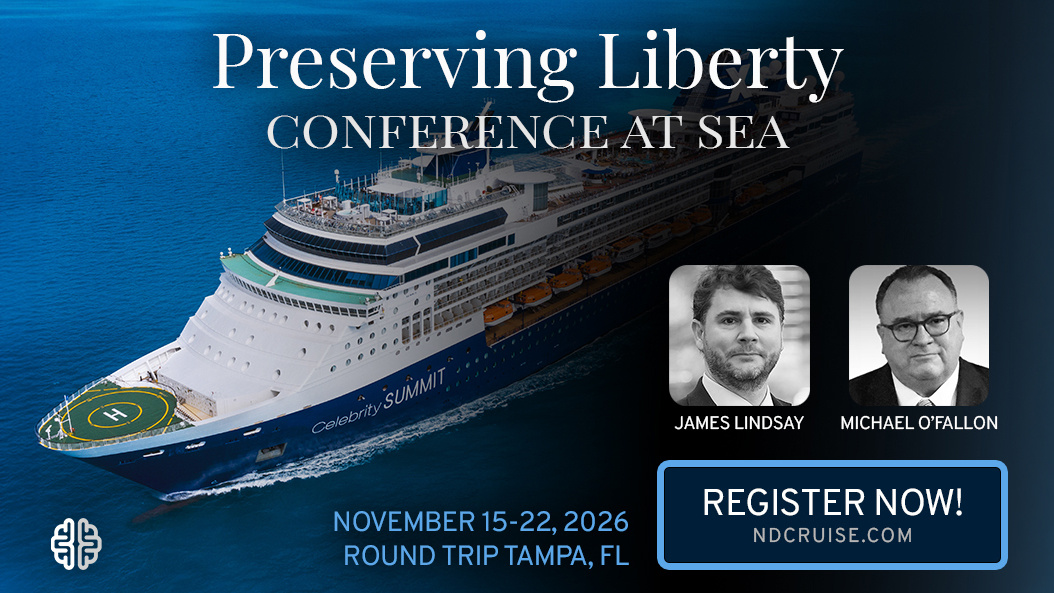
Today is your last chance to to get early bird savings on our upcoming conference at sea. Rates increase tonight at 11:59pm so register now so you don't miss out on this exciting cruise with James Lindsay & Michael O'Fallon!
https://NDCruise.com

post photo preview

I keep telling Canadians they can't win the sports until they quit being Communists, but they never listen.
https://x.com/Breaking911/status/2073611370629570762

I'm somewhat excited but sort of laughing to myself about Trump saying "we're not gonna let that happen" while speaking of Communism in the United States. Someone should sit down with him and show him what happens in our schools. Lol

post photo preview
The Third Rail and the Fifth Column
by James Lindsay

During the Spanish Civil War in the late 1930s, Nationalist Generalissimo Francisco Franco advanced on Madrid with the intention of taking it with four columns of soldiers. In the midst of the advance, another Nationalist general, Emilio Mola, was asked on a radio broadcast which of the columns would succeed in taking over the city and finalizing the Nationalist coup. Mola replied that it would be the hidden “fifth column” of supporters and sympathizers within Madrid who would prove decisive by rising up and sabotaging the Republican defense from within.

Ultimately, General Mola was wrong. No “fifth column” arose from within the city, and the Republicans held Madrid. Nevertheless, the phrase immediately caught on. A fifth column to this day refers to a group of people who undermine a larger group, institution, movement, or nation from within.

The Woke Right is a Woke fifth column working internally against America, MAGA, the (American) Republican Party, and the American conservative movement, which is the last anchor tethering our country to the Constitution, common sense, and reality. Whatever might be its primary sources of intention and energy—be those foreign influence, “Deep State,” Democrat, or an organic and opportunistic paleoconservative revolt, or some combination—being a fifth column in the Woke assault against American and the West is the role it certainly plays.

The question is how it has been so successful at recruiting and gaining momentum, given that many of its views are wildly out of step with American values and the traditional perspectives of conservatives in America. Their nativism, isolationism, (genuine) racism, hostility toward Jews and Israel, racial minorities, women, sexual minorities, and legal immigrants, and undeniable antisemitism, not to mention their skepticism of free-market economies, the Constitution, religious liberty, conservatism itself, and a minimalistic state, do not reflect the values of generations of American conservatives or America overall.

Many reasons can be given for their meteoric and bewildering sudden rise. Among them, broad distrust in established institutions and favoring “trusted voices” within the movement who appear to be leading them astray is perhaps at the front. Frustration with the difficulty in pushing back against the Woke Left and its infiltration into our institutions is surely another significant component. Multiplying and tapping the alienation of our young men is definitely another. The outright force of money and the apparently sudden shift of so many voices all at once just in the last year, taking the movement by sudden surprise, must also contribute.

Both within and beyond these reasons, however there is a motivating factor that demands our attention: recruitment upon the “third rail.” The third rail, unlike the fifth column, is a metaphor. It literally refers to the electrified “third” rail subway trains use to power themselves. The idea is that if you were to fall down into the tracks, touching either of the first or second rails, where the wheels of the trains run, would result in nothing particular, but stepping on the electrified third rail would result in your electrocution and destruction.

The “third rail” metaphor therefore describes locations in political discourse that, if touched, will blow up your (professional) life. To the politically naive, these opinions appear to be benign, perhaps even statements of fact, but they work like a political tripwire, causing a huge reaction when they’re aired. A classic American example is attempting to explain the cultural significance of Confederate symbols to many (especially Southern) Americans. No matter how accurate, nuanced, or careful the speaker might be, it will likely be taken as a defense of slavery and sedition, and damage someone’s reputation or career (especially a political career).

Here’s the problem. A population can be pushed to the point where it will regard as bogus and evil the destruction an honest person can expect to receive for stepping on a third rail. For example, someone who earnestly defends the meaning he and many others hold for Confederate symbols might get blown up for “defending slavery,” even though he didn’t. If that happens enough, in unfair enough ways, for long enough, the public might revolt against the injustice of the political third rail.

That’s where we find ourselves with many issues all at once now as the lies of the extended Woke Left collapse around us, and the Woke Right fifth column is recruiting precisely by taking advantage of that situation.

There are two particular dynamics that have played a crucial role with regard to what we might call the Politics of the Third Rail that has enabled the rise of the Woke Right as a fifth column.

First, there’s the uncomfortable fact that many points that reside on the third rail are at least partially true but remain completely politically incorrect. This mismatch is a political powder keg; a bomb waiting to go off. When people aren’t allowed to say true things for undeniably political reasoning, the taboo is regarded not as politeness but censorship of potentially important or meaningful views. A reaction that embraces these views is more or less eventual in such a circumstance, and chances are, it won’t be nuanced when it arrives.

In fact, it usually will not be nuanced at all. The nuanced, careful, accurate voices will already have been shouted down, punished, or destroyed by the time the backlash arrives. The only voices left will not only be less careful by definition but will also be angry enough to assert more than the full truth of the issue. With regard to the issue of the Confederacy, they will not stop at the idea of revering a “heritage” of sovereignty and not being told what to do by a meddling federal government or outside power. They may start explaining why, in their view, slaves were better off than black freemen later, up to and including today.

Because these brash voices look brave and honest compared to the effete political correctness they’re shattering, they’re attractive. They will recruit followings. These followings will, by their intrinsic dynamics, go too far. Worse, by then, even if more reasonable voices step into the fraught space, they’ll sound timid, rather than brave, for their measured approach to the controversial issues, and they’ll fail to stem the tide as it flows toward radicalism and insanity

Second, there’s the fact that the “politically correct” Woke Left has created more, and more obviously bogus, political third rail space than any polite society ever could dream of—or that one will tolerate indefinitely. Undeniably true things like that it is perfectly acceptable to mention the completely banned “n-word” without using it—say by quoting Huckleberry Finn, or explaining the historical use of the term itself, or quoting a popular hip-hop song that says it every second line, or explaining that certain words in Mandarin and Korean sound similar but aren’t it and saying those—are rendered completely verboten, and seemingly arbitrarily. One will notice, for example, that “black people are allowed to say it,” and that many do, enthusiastically, casually, and even viciously, but that a racial double-standard has to be maintained for what appears to be “Woke” reasoning.

The result of this Wokification of discourse is that there’s an incredible and intolerable amount of patently ridiculous discursive and political “third rail” space that makes a great deal of honest discourse and real, necessary problem-solving impossible. As problems mount, the maintenance of the political third-rail space rightly begins to be identified as a big part of the festering problems, and it will be rebelled against. As this political and discursive pendulum swings back, as described above, it will not do so gently.

This isn’t a matter of mere perception, petulance, or, especially, latent bigotry, as the Woke Left and too many in polite society might assert. It is actually the case that the Woke Left has over the last two or three decades succeeded in turning an incredible number of legitimate political and cultural concerns into third-rail space that can hamper communication, prevent finding solutions to genuine problems, chill speech, and unjustly ruin lives. It is as though the Woke Left turned the first and second rails into electrified rails, preventing the train from being able to run and making its very carriages pose a real danger of electrocution.

It is both in and upon this greatly expanded third-rail space in political discourse that the fifth-column Woke Right has succeeded in doing most of its recruiting. Both in the name of and by “boldly” stepping onto the first and second rails, which are unjustifiably electrified, they have occupied both bogus and real third-rail political space and stand inside it as defiant rebels, unafraid of the shocks and calling people to join them. What it represents is freedom, fun, and liberation from an oppressive political, professional, and discursive regime that took advantage of the fundamentals of polite political taboos in order to steal and abuse power. It is therefore a successful recruiting methodology for a radical reactionary movement that rejects not only the bogus political correctness of Woke Left cultural mores but also the genuine guardrails of polite society in favor of a new form of liberation.

The fifth columnists in the Woke Right are using this dynamic to recruit and to drive wedges that undermine their political targets, particularly the United States itself and its conservative movement and institutions therein.

When we see commentators like Tucker Carlson “just asking questions,” what he is doing is stepping into third-rail space and recruiting, including many people who know better but are also now too pissed-off to care. When we see agitators like Nick Fuentes transgressively violating taboo after taboo (with what amounts to Right-wing Queer Theory), what he is doing is standing directly on the third rail and laughing as he redirects the bolts back at his enemies. When we see hordes of “Dark MAGA” influencers follow suit, they’re leading an army of mostly disaffected young men to fill the vacuum created by altogether too much third-rail space in contemporary cultural and political discourse, much—but importantly not all—of it artificial, odious, and purposefully malicious in the first place.

Thus, a fifth column that seeks to destroy America through its conservative movement has been able to recruit an angry army that has become shameless in the process of shedding false causes for shame. The are the fifth column standing on the third rail, and they threaten to undermine our shining city on the hill from within as our enemies advance upon us from without.

How can they be dealt with? One way only exists to us. We must steal their thunder (pun intended

We have to be honest. We have to occupy third-rail space ourselves with honesty, integrity, and nuance. We must be unafraid to tackle well these touchy issues that the Woke Right fifth-columners are tackling badly, and we must create a new civic norm of championing, not attacking, those who enter those spaces honestly and in good faith in order to deal earnestly with what partial—or sometimes full—truths reside there.

Read full Article
post photo preview
Reciprocal Tolerance
by James Lindsay

In a footnote in his famous (or infamous) The Open Society and Its Enemies, Karl Popper relates a famous (and famously misunderstood) idea called the Paradox of Tolerance. It is, as it turns out, one of the most important concepts that any free society much reckon with—and solve.

Popper only devotes a single paragraph to this fundamental paradox of freedom, which can be summarized as “being tolerant of intolerance eventually results in an intolerant society, but being intolerant of intolerance is already a feature of an intolerant society.” In that paragraph, he outlines a solution, though he’s thin on the details. Here’s how he phrases it, in full:

Less well known [than other paradoxes] is the paradox of tolerance: Unlimited tolerance must lead to the disappearance of tolerance. If we extend unlimited tolerance even to those who are intolerant, if we are not prepared to defend a tolerant society against the onslaught of the intolerant, then the tolerant will be destroyed, and tolerance with them. In this formulation, I do not imply, for instance, that we should always suppress the utterance of intolerant philosophies; as long as we can counter them by rational argument and keep them in check by public opinion, suppression would certainly be most unwise. But we should claim the right to suppress them if necessary even by force; for it may easily turn out that they are not prepared to meet us on the level of rational argument, but begin by denouncing all argument; they may forbid their followers to listen to rational argument, because it is deceptive, and teach them to answer arguments by the use of their fists or pistols. We should therefore claim, in the name of tolerance, the right not to tolerate the intolerant. We should claim that any movement preaching intolerance places itself outside the law and we should consider incitement to intolerance and persecution as criminal, in the same way as we should consider incitement to murder, or to kidnapping, or to the revival of the slave trade, as criminal.

Radicals on both the Left and the Right have run with this famous paradox of free societies in various ways. For example, it is popular on the Left to present only Popper’s conclusion about claiming the right to suppress intolerance without expressing his rather strict criteria for that suppression. On the (radical) Right, on the other hand, this formulation has been criticized (e.g., by R.R. Reno in Return of the Strong Gods) as planting a dialectical seed that turns tolerance into totalitarian intolerance over time

In these analyses, the Left is dishonest, and the Right is simply wrong, as is their wont in each case. The Left desires, like their Nazi pseudo-nemesis Carl Schmitt, to have the power to declare the intolerant enemy and have him destroyed without acknowledging how seriously Popper takes the conditions of such action. The Right simply fails to recognize that the devil is in the details for working with such a situation in reality. Of course, by way of its error, the Right also desires, like their Nazi semi-hero Carl Schmitt, to have the power to declare the enemy and have him destroyed.

Though Popper doesn’t develop the idea further, and though the devil will remain in the details, he does lay out criteria by which intolerance of the intolerant might be acted on wisely, as opposed to unwisely, to borrow from his own phrasing. This is where the rubber meets the road for the Paradox of Tolerance, to quote the relevant section again

…for it may easily turn out that they are not prepared to meet us on the level of rational argument, but begin by denouncing all argument; they may forbid their followers to listen to rational argument, because it is deceptive, and teach them to answer arguments by the use of their fists or pistols.

What Popper is proposing here, though thin on the details, is a theory of tolerance in free society. He is saying we must retain the right to suppress intolerance that might answer our tolerance with a combination of irrationalism, intolerance, and violence. He clearly states we should regard such militant and subversive intolerance as a kind of incitement and refuse to protect it as free expression.

In practice, this is trickier than can be contained in a footnote. It is not sufficient to invoke legal intolerance against views that are merely irrational, anti-rational, that denounce argument, or that forbid followers from listening to rational arguments because they are allegedly deceptive. The law already has some mechanisms for dealing with intolerance that looks to answer arguments with fists and pistols, imperfect as those might be. Further, these are not the central part of the problem of overreaching tolerance.

Popper seems to miss the most essential characteristic for finding a strong solution to his paradox. This essential characteristic is located in the fact of the paradox itself: the intolerant will not reciprocate tolerance, given the opportunity. In essence, what he is looking for, but does not find, is a Golden Rule for the issue of tolerance.

We might call such a strong solution Reciprocal Tolerance. In short, Reciprocal Tolerance would be a doctrine like: we, the people of a free society, should extend tolerance only to any who, given power over us, would also extend tolerance to us in return. That is, we will treat others as we can reasonably expect they would treat us, as determined from their own words, deeds, charters, relationships, and organizational principles.

This principle of Reciprocal Tolerance is not reversible like through some postmodernist trick or psychopathic “DARVO” because it is applied from a free society. In full generality, it is that free societies are perfectly free to be intolerant of any politically intolerant political organization.

This principle is also not a principle regarding speech. People are free to say whatever intolerant, hateful, or bigoted thing they want, even in their group settings. It would apply to any political group and its members or leadership that organize a faction with the expressed intention of acquiring political power at least in part in order to revoke tolerance from others who, absent the case of such intolerance, would not revoke tolerance from them.

Free societies live or eventually die based on their solution to the Paradox of Tolerance. Tolerance cannot be unlimited or it will be exploited and taken advantage of, but it also must be broad enough to keep society free

The solution is toleration in the bounds of good-faith, Reciprocal Tolerance. We are under no obligation socially to tolerate subversives who operate in bad faith, nor are we under any obligation legally to tolerate any demand for tolerance that would not be reciprocated if the people making the demand themselves got their hands on the levers of power. While the first of these may only be a social convention unless people are illegally deceived and defrauded, the latter certainly falls within the range of legally actionable responses to intolerance we could enforce well within the boundaries of the Constitution, which we are seeking to protect and preserve.

Once either of these fouls against a free society is detected and verified, some generally acceptable and legally narrow mechanism of intolerance against them must be able to be employed. Practically speaking, at a minimum, there is no reason to extend tax-exempt status to nonprofit organizations that explicitly espouse agendas to amass power to abolish the existing tolerant political order in favor of intolerant ones that would, if successful, revoke tolerance of those who allowed their growth. Further, entities that espouse or articulate such beliefs that receive funding from foreign sources should not be tolerated.

A principle of Reciprocal Tolerance could therefore serve as a solid basis for both social norms and legal activity to better navigate the Paradox of Tolerance that lies at the heart of every society that wants to be free. Organized intolerance ought not to be tolerated for precisely the reason that it would withdraw tolerance from those it seeks to rule.

Read full Article
post photo preview
What George Washington’s Death Can Teach Us About Woke
by James Lindsay

President George Washington died at his home on December 14, 1799, at the age of 67. He died, as it turns out, of a particularly bad and sudden upper respiratory infection, most likely strep throat, that the doctors of his day (the best available) did not know how to treat. (Penicillin as a treatment wasn’t discovered until 1928.)

After going out on a cold and wet evening on December 12 to inspect his fields, President Washington returned to Mount Vernon to rest with a tickle in his throat. On December 13, he continued to work outside in the cold, wet conditions, and by evening realized he had a problem. By morning on December 14, he had a full-blown, emergency infection and got Martha to summon help. Doctors were on the scene and went to work that morning.

Not knowing how to treat President Washington’s sudden illness, his doctors made his predicament worse by using the best of 18th century “medicine” on him, starting with extensive blood-letting. In fact, they drained nearly half of the great man's blood from his body hoping to cure him. It made things worse, at the very least weakening him greatly while he was otherwise afflicted.

They also had him drink and gargle a number of potions that would have blistered his throat and increased the inflammation while doing nothing to combat the infection. Some of these included Spanish fly, potions made out of infusions of beetles, and a solution of butter, molasses, and vinegar. They also gave him a completely unhelpful enema.

Washington, certainly partially as a result of his “medical care,” succumbed to this now-trivial disease in under 24 hours, said goodbye to his family as the end drew undeniably near, closed his eyes one last time, and died, allegedly with the words “‘Tis well” being the last words from his lips before he went. That night, America lost a giant, perhaps in an untimely fashion.

Now imagine for a moment that among his doctors one had a stroke of divine inspiration (or connecting the dots between other observations he had made in similar circumstances) that led him to conclude before any treatment began that, in fact, The President was suffering from a simple bacterial infection of the upper airways and trachea. Imagine further that he was able to convince his fellows of this stroke of accurate and correct insight.

Would acquiring this accurate diagnosis have cured President Washington? No, not on its own.

Would President Washington still have succumbed and died of this simple but aggressive infection? Probably, but that cannot be known.

Even if he would have still died, would that diminish the value of the accurate diagnosis? Not at all, and that’s the point.

The accurate diagnosis alone could not have saved President Washington’s life, but one thing we might guess is that understanding that his illness was caused by an invading pathogen growing in his throat that had nothing to do with “bad blood” or “evil humours,” he may well have avoided the blood-letting in his treatment, saving much of his strength for fighting the severe but routine infection.

Furthermore, the potions and concoctions he was given to gargle and drink might have been better purposed to deal with a direct infection, per long experience with animals or other people, and perhaps would have been chosen in a way that was more beneficial or benign, especially if some understanding of the role of inflammation was part of the blessed miraculous insight of our hypothesis. Maybe they would have been chosen only for his comfort and to keep his airways clearer.

It’s very unlikely that his doctors would have realized that a certain strain of mold properly prepared and administered would have surely cured him, but they might have realized their primary focus should have been on keeping him breathing as well as possible while his body fought the infection, potentially preventing many of the other, harmful things they did.

One young doctor did propose such a solution, in fact, recommending a radical new surgical technique at the time called a tracheotomy, which was not performed. Whether or not he understood the situation (likely not), he did understand that the emphasis was to keep Washington breathing until he could recover under his own power (which would have been increased had he not been drained of half his blood and given to drink various potions, some of which were surely unhealthy). Had that surgical intervention been performed cleanly and correctly, many today think, Washington likely would have survived.

In other words, a correct diagnosis might or might not have saved President Washington in that last dark month of the eighteenth century, but it would have certainly achieved at least three effects:

1) It would have ruled out dangerous false “solutions” like blood-letting and perhaps some of the concoctions he was given;

2) It would have focused energy and attention on doing more productive, even if insufficient, things than were done, which combined may actually have saved The President's life; and

3) It still would have been correct and therefore a robust foundation for pursuing and achieving real, reliable solutions to the same problem in future circumstances, independent of Washington’s fate.

That is, getting an accurate diagnosis matters even when the diagnosis itself is not sufficient to solve the problem at hand. The likelihood of finding a viable solution to a problem goes up dramatically with an accurate diagnosis, and the likelihood of avoiding bad false “solutions” in the process also goes up dramatically in this case.

Now let’s turn our attention to Woke, a societal infection if ever there was one.

Woke, which is ultimately a group-based victimhood complex channeled through social philosophy, is always an incorrect understanding of the phenomena of society. It therefore cannot lead to correct solutions, only to ridiculous things like blood-letting (criticism, in metaphor).

It does not matter if we are talking about left-wing Woke, right-wing Woke, postmodern Woke, modern Woke, or premodern Woke. Woke is a petulant misunderstanding of the circumstances, therefore it cannot provide a correct diagnosis. Therefore, again, it cannot, except by a combination of luck and failure, produce a meaningful solution.

To wit, Marx did not have good criticisms of society, capitalism, free markets, free trade, liberalism, feudalism, slavery, or anything else he criticized—as is often asserted—because all of his criticisms relied upon his own modern-era Woke theory of social alienation and conflict that is fundamentally not correct. (It is sociognostic and just as heretical as any other Gnostic heresy, as such.) The solutions he applied are wrong not merely on their own but also because his diagnostic framework is wrong.

Keeping the diagnostic framework while recommending different solutions (right-wing Woke, or Woke Right) will not fix the fundamental problem because the diagnostic framework is still wrong. Therefore, the prescribed solutions will also be wrong. Right-wing Woke, maybe like Washington’s enema, is not an answer to left-wing Woke.

Getting accurate diagnoses about bad social theory—not by using it—is not on its own a solution any more than one of President Washington’s doctors realizing he has a strep infection would have been a cure. It is, however, the foundation for finding a cure, or at least for favoring minimal and palliative care dedicated toward the right objectives (keeping him breathing and full of his own blood while his body fought the infection) rather than taking detrimental wrong turns.

Similarly, Woke theories and obsessions with power, victimhood, and group identity, but for “right-wing” causes, is an easily avoidable wrong turn that can be avoided by understanding that Woke theory and its obsession with power, victimhood, and group identity are the disease itself. Or, more deeply, that both are aspects of the same dialectic that is making our society sick.

I hope Western Civilization can survive, even if we are unaware of the cure. Like the body of President Washington in December 1799, it already has many of the resources (like the Constitution) needed to fight the Woke infection it is currently suffering from—as long as we keep it breathing and don’t unnecessarily weaken it with false “solutions” like more Woke, more criticism, more victimhood, more identity politics, and more obsession with power, even if they’re pointing in the “other” direction.

Read full Article
See More
Available on mobile and TV devices
google store google store app store app store
google store google store app tv store app tv store amazon store amazon store roku store roku store
Powered by Locals